If the Buddha wrote a bio

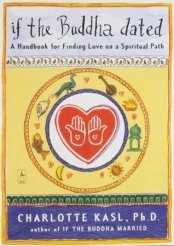
If the Buddha Dated.jpgYou might have seen these books: If the Buddha Dated, If the Buddha Married? I loved the section in If the Buddha Dated on writing a dating profile that might attract an appropriate mate. Author Charlotte Kasl takes the reader through the various versions that you might write, starting with one that’s basically a laundry list of all the qualities you are seeking in your would-be partner. As she continues, the profiles get a little more “enlightened” and more and more interesting, and you start realizing that perhaps describing your values, and asking questions, might be more effective than presenting an impossible checklist of criteria and scenarios that might not ultimately lead to a mutually-fulfilling relationship, anyway.

The final sample profile simply reads,

Who are you? Who am I?

I’ve been thinking a lot about this because it’s now been exactly 27 days since I was asked to write a bio for the Order members of my Buddhist community, or sangha, as Buddhist communities are known.

Now I am nothing if not a writer, and I have no problem writing bios; I’ve written gobs of them. Bios for online dating profiles (at least four different ones I am sure about, and probably more, all partially inspired by Charlotte Kasl, if decidedly more verbose). Bios for speaking gig programs. Bios for job applications, for teaching yoga, for the inside of my book, for websites, for fellowship directories, for high school and grad school alumni journals. 20 word bios. 120 word bios. 250 word bios, one-pagers. The list goes on and on.

So why is this one stumping me?!

The thought process goes something like this: “I’d better do this one properly. Wait, no, I’d better make it seem like I wasn’t worried about it at all, that’s more ‘spiritual.’ Continue reading “If the Buddha wrote a bio”

Your Money Or Your Life: one of the most influential books of my life

vicki
Of course this woman is one of my role models (Source: yourmoneyoryourlife.com)

I finally had a chance to read the new edition of Your Money Or Your Life: 9 Steps to Transforming Your Relationship with Money and Achieving Financial Independence, a book that had a huge influence on me when I first discovered it back in the late ’90s.

With this book, co-author (and now friend!) Vicki Robin sparked the FIRE, or  “Financial Independence, Retire Early” movement… though few people were aware of this until relatively recently. She is a huge inspiration to me, and I definitely aim to be like her when I grow up!

The new edition includes a wider range of examples from Millennial types, and the chapter on investing is FAR better aligned to today’s investing climate.

YMOYLIntrigued? Vicki has generously shared a VERY detailed summary on the fancy new YMOYL website, but I still suggest you buy the book, and spend some time with it!

In addition to calculating how much money we’ve earned over our entire lives, and what we have to show for it (aka our net worth; this is Step 1), we’re instructed to calculate our real hourly wage, a function of our life energy, and track every cent that comes into our goes out of our lives (Step 2). And we get into the habit of tallying up our spending by categories that are relevant to our lives, and we regularly convert those monthly spending totals into hours of life energy (Step 3).

But my favorite step by far is Step 4: Three Questions That Will Transform Your Life: Continue reading “Your Money Or Your Life: one of the most influential books of my life”

Creativity = (Stock and Flow) + (Morning Pages)

I’ve been digging Austin Kleon’s work lately. There is so much excellent fodder in both Steal Like an Artist and Show Your Work!, and I highly suggest subscribing to his e-newsletters for a regular dose of even more goodies.

The concept he stole-then-shows that intrigues me the most is that of Stock and Flow:

Stock&Flow
A page out of Austin Kleon’s book Show Your Work! 10 Ways to Share Your Creativity and Get Discovered; I stole this image from his blog.

Being the nerd that I am, I pored over the original Robin Sloan Stock and Flow article he references, along with its excellent comment thread, which then led me to Continue reading “Creativity = (Stock and Flow) + (Morning Pages)”

Book review: Olive Kitteridge by Elizabeth Strout

OliveKitteridge

We were going to be visiting Scott’s family in Maine and I’d never been there before, so I wanted to read something that was set in that state; Scott did a bit of research and suggested Elizabeth Strout’s Olive Kitteridge. Extra points for a Maine novel written by a Maine author!

This book reminded me of:

I kept thinking back to Anne Tyler (Ladder of Years especially, not that I can remember a single detail other than how the book made me feel) and Alice Munro’s Still Life in terms of the female character’s experiences. Alice Munro again because the novel is a collection of short stories that could very well stand on their own. And Wendell Berry because of Strout’s choice to illuminate one small town through the eyes of several very different inhabitants and their very different stories… though to be fair, I think Strout covers a lot more ground in terms of humanizing a wider range of characters and situations.

This book got me thinking about:

…the many different ways aging relationships can go.
Apparently I had unconsciously assumed a very narrow spectrum of feelings and/or options available to people that had been in a relationship for decades, because I was very pleasantly surprised by the number of representations in this book.

…the fraught nature of parent/child relationships.
So many of the characters and scenarios reminded me of just-slightly-more-extreme versions of people and relationships in my own life Continue reading “Book review: Olive Kitteridge by Elizabeth Strout”

I want to talk to someone about Wendell Berry

LoadingBrushI love Wendell Berry. I think I’ve read more of his books than any other author’s. I’ve had the honor of seeing him speak on three different occasions. When he came and spoke to a rapt crowd at a packed barn in my (then) small town, I was thrilled that he signed my post-it-note-laden, cover-is-delaminating, I-recommend-it-to-everyone-who-expresses-an-interest copy of The Art of the Commonplace. I have had nothing but massive respect for the man and (most of) what he stands for.

With that context in mind, it kills me to admit any crack in my admiration for Mr. Berry. Now that I’ve started examining that crack, however, I’m realizing that I’ve had a few misgivings all along. This has sparked a familiar sort of grief: the grief that comes from removing someone from a pedestal I had them on.

In the first essay in The Art of Loading Brush (Counterpoint, 2017), “The Thought of Limits in a Prodigal Age,” Mr. Berry repeatedly compares screen addiction to drug addiction, but worse “because it wears the aura of technological progress and social approval.” Continue reading “I want to talk to someone about Wendell Berry”

The Solstice is Our Anniversary

The paradoxical thing about monogamy, for me at least, is that it took someone who doesn’t insist upon it to inspire me to live it so willingly.

Read on for two poems (one that speaks to the inevitably-ephemeral nature of relationships, and one that speaks to the phenomenon I described above), the story about how Scott and I came to find ourselves in a relationship the second time around, and a bit of Wendell Berry’s ever-inspiring wisdom.

Sonnet of Fidelity
by Vinicius de Moraes

Above all, to my love I’ll be attentive
First and always, with care and so much
That even when facing the greatest enchantment
By love be more enchanted my thoughts.

I want to live it through in each vain moment
And in its honor I’ll spread my song
And laugh my laughter and cry my tears
When you are sad or when you are content.

And thus, when later comes looking for me
Who knows, the death, anxiety of the living,
Who knows, the loneliness, end of all lovers

I’ll be able to say to myself of the love (I had):
Be not immortal, since it is flame
But be infinite while it lasts.

I discovered this next one in the book Loving and Leaving the Good Life, by Helen Nearing; she had sent it to her husband, Scott Nearing, in response to a poem he sent her while they were separated by an ocean:

The Wind Bloweth Where It Listeth
by Countee Cullen

“Live like the wind,” he said, “unfettered,
And love me while you can;
And when you will, and can be bettered,
Go to the better man.

“For you’ll grow weary, maybe, sleeping
So long a time with me;
Like this there’ll be no cause for weeping;
The wind is always free.

“Go when you please,” he would be saying,
His mouth hard on her own;
That’s why she stayed and loved the staying,
Contented to the bone.

***

Because Scott and I didn’t see each other for two and a half years following our first date (except for one unacknowledged, wordless encounter in the doorway of Green Apple Books), I count our second date as our anniversary.

Except that I can’t really call it a date because it wasn’t really meant to be a date. We’d been hanging out platonically for several weeks, going to shows and having philosophical discussions, and had even gone on a double date. Which is why it hadn’t occurred to me that it might be awkward to invite Peter, a friend from work, to join us at The Independent on the evening of the Summer Solstice, 2016… Continue reading “The Solstice is Our Anniversary”

Inverness Almanac: a biased review from a contributor

The first volume of the Inverness Almanac moved me on a number of levels. The publishers, a group that coalesced around a dear friend of mine, curated such a delicious collection of photographs and drawings and writings and maps and recipes and seasonal markers! And then they pulled it all together into a stunningly beautiful package, a book that is a work of art in and of itself.

I had been visiting West Marin since before my birth, appreciating its topography and ecology since I’ve been a conscious human, and living there for years when they released Volume 1. And yet the sense of place conveyed within this Almanac opened my eyes to my surroundings in a completely different way. It was as if my powers of observation had been magnified. Everything seemed different, more luminous, containing so much more to discover if I could sit still long enough — or return frequently enough — to receive it.

That first Almanac also shook awake my writer’s muscle. I found myself unable to pass through the landscape without composing works that wanted to find their place among other contributions, and I vowed to submit something to the next Volume. Perhaps the San Andreas fault poem that seemed to be writing itself every time I entered Olema Valley? Or a drivers’ guide to Bolinas Lagoon, sharing my favorite seasonal points of interest?

Continue reading “Inverness Almanac: a biased review from a contributor”

Resources for dating in small communities

For most of the decade from 2007-2017, I lived in West Marin. Bolinas was home for most of that time but I also spent a lot of time in Point Reyes Station (where I rented office space for a couple of years). These small towns are nestled amongst some of the most beautiful places I have ever laid eyes upon, much less had the privilege of living in.

West Marin’s relatively small population presented (and still presents, I assume?) some challenges in the realm of intimate relationships. Though serial monogamy seemed to be the norm, it wasn’t the only relationship structure practiced within in this constellation of towns. We dated one or more of our neighbors; we became exclusive and shacked up for a spell; we broke up, moved away, and/or moved on to new partners… and not always in that order.

The web of current and former relationships grew ever-more complicated with the turn of each season. Through it all we still attended all the same social gatherings and were more or less friendly to each other in public, no matter how strong the jealousy, resentment, and anger raged in internal or private conversations.

Continue reading “Resources for dating in small communities”

Good Food, Great Business at the Commonwealth Club

CommonwealthWant to learn more about financing your business, working with co-packers, marketing for increased sales, working with retailers, and more… from a group of kick-ass women who really know what it takes to run a successful food business? Listen to this Commonwealth Club recording of a recent event titled Good Food, Great Business: How Food Startups Take Good Ideas from Concept to Success.

Joining me in presenting to the sold-out crowd were Kathryn Lukas, CEO, Farmhouse CultureJill Litwin, Founder and CEO, Peas of Mind; and Grace Erickson, General Manager, Ocho CandySusie Wyshak, Author of the new book Good Food, Great Business (check it out!), organized the event and served as our moderator.