I read Ling Ma’s Severance back in March and keep forgetting to give it a glowing recommendation, especially for those of you who are still in lockdown.
A few of the elements that really worked for me:
A fascinating perspective on the benefits (!) of boring office jobs;
A mysterious flu with origins in China;
Post-pandemic dystopia;
Cult dynamics;
A solid critique of the internet and how we use it;
Philosophical differences revealed through a romantic relationship;
A Chinese-American immigration story;
The choice between going with the flow vs joining the revolution vs saving yourself; and
Geekery related to specifics of publishing books (think: paper weight, binding, and cover materials) to remind me of my former life as a publisher.
The world today is very different from that in which Buddhism originated and flourished… The challenge Buddhists face today is to find ways of communicating and practising the Dharma that are truly effective in these new circumstances. The situation seems to call for renewal in the Buddhist world, faithful to the Buddha’s own teaching, yet addressing the circumstances we find ourselves in now.
A problem of the dharma today is that it has become so limited. It has become constricted inside of a kind of fear. We want to maintain control of it, so we resist it evolving as it always has…
…we miss the opportunity before us to liberate ourselves from the obscurations that keep us from knowing who we are, from knowing each other, from knowing that our birthright is exactly love.
Obscuring the path of liberation for us all, simply put, is race. And when I say race, I mean race and ethnicity and heritage and skin color and all of those things that we have conflated into it for hundreds of years.
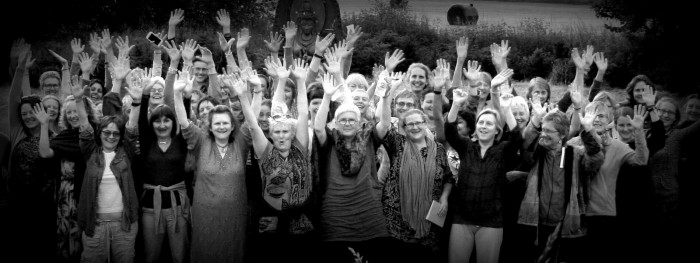
I found this image on the website of an international retreat for women “like me” who are training for Ordination into the Triratna Buddhist Order. [Source]
I am currently training for Ordination in the Triratna Buddhist tradition. After years of of studying with a number of Tibetan Buddhist teachers in India, Sangharakshita, a man who was brilliant and British, insightful and white, brought his unique vision of the Dharma [= teachings of the Buddha] back to England. From there, this vision has spread throughout the so-called “Western” world and beyond.
The Buddhist movement Sangharakshita founded is the Triratna that I first encountered at the Auckland Buddhist Centre, after a decade+ of intermittent Buddhist study and practice. I may just as likely have encountered it at the San Francisco Buddhist Center, or any of the dozens of Triratna Buddhist Centers located around the world.
I am deeply grateful for the clarity and accessibility of the Triratna teachings, and even more so for the beautiful Sangha [=spiritual community] that makes the Triratna movement so unique amongst all the other Buddhist disciplines.
And.
I struggle daily with several intersectional aspects of Triratna’s culture, as it manifests at the more-distributed-than-centralized global and local levels. The movement’s history stings of appropriation, colonialism, and patriarchy. Formal Dharma study groups and people training for ordination are separated by gender, with no formal support for people who do not identify as “male” or “female.” At my local Center, due to the availability of teachers, it’s a lot easier to join a study group if you identify as a man, while many women wait months — and must make formal commitments — before being assigned to a group.
There doesn’t seem to be an accepted path to Ordination for parents of young children or people who otherwise don’t have the ability to attend retreats for long periods of time. The retreat Centers we use are not accessible for people with limited mobility, which means that many of our older Sangha members, and those who use walkers or wheelchairs, cannot attend.
There is quite an openness to the queer community. On the male side of the gender divide, that openness has bordered on (crossed into?) concerning abuses of power over the course of Triratna’s history. All but one of the authors whose work is disseminated by the publishing company associated with Triratna appear to be male, though it’s possible I’ve missed someone.
There is subtle scorn (or is it simple racism?) directed at “cultural” Buddhists, a term used for those who were born into the tradition without having actively chosen to practice its teachings. “They’re doing it wrong; we’re doing it the right way, as the Buddha intended” is the not-so-subtle subtext.
***
Triratna is my spiritual home. The more I learn about Sangharakshita’s history, the lineage of his teachings, and the beautiful and diverse people who are the embodied continuation of that lineage, the more comfortable I become with the late founder of this movement.
And.
I would like to keep my eyes wide open to the suffering that follows from the many issues I mentioned above, many of which stem from the culture he created.
***
I study, first and foremost, as I am encouraged to do, the Dharma as formulated by Sangharakshita and taught by Triratna teachers. Fortunately for all of us, there are far more recorded talks and videos from Triratna Order members of color than there are written works. I am deeply honored to be able to learn from teachers as insightful, skilled, and experienced in the importance of diversity and inclusion work as Vimalasara and Viveka.
And.
To keep my cup full, I regularly seek out diverse Buddhist teachings from people who practice in traditions other than the Triratna community. There is so much amazing anti-racist work happening in the Insight Buddhist Community in North America that Buddhist of any affiliation can learn from, for instance. I share these resources in the hope that we all can benefit from — and see ourselves in — the many facets of the dazzling Dharma jewel.
***
To the extent that I have the energy — it takes a lot of emotional labor! — I am committed to actively working with my local Sangha to build a more inclusive approach to sharing the Dharma. This includes regularly engaging with my friends and teachers and Order members and fellow students in designing new ways to communicate with and learn from each other. It includes doing my best to stay engaged, even when it seems as though my concerns are being minimized or dismissed. I try to model the inclusive behavior I would like to see.
And.
I regularly slide into anger, into indignation. I skip right over “the gap” [between feeling and wanting something to be different] more often than I can keep track of. I wonder how regularly I break the precepts that pertain to kindness, generosity, and mindfulness. I am overcome with feelings of Hrī [=remorse] when I reflect on the impact of my unskillful actions. I know that my tone has many times resulted in people feeling shut down or minimized themselves. The cycle of samskara [=habitual tendencies] continues.
***
I try to remember that all things arise based on conditions. I work to include in my compassion all the people who “aren’t racist” but who do not yet fully understand their privilege or the impact of their behavior on others less privileged… which I do not believe is their fault; rather, I see it as a function of their own conditioning.
And.
I say the name of George Floyd aloud, and remind us about the importance of the Black Lives Matter movement, lest we carry on with our Dharma activities as if this moment of great suffering were not happening. Yes, all beings experience suffering. And we need to be clear that suffering is happening in a very specific way — murder, often at the hands of police! — for Black people right now. And that this suffering is related to the suffering of Māori at the hands of the NZ police, and the suffering of indigenous people around the world. And that this suffering is related to the climate crisis. And that our liberation is tied up in the liberation of Black people in the US, whether we choose to look at those connections or not.
***
This represents what is most alive in me today; tomorrow, I might say something completely different. May we all stay open to the possibility of holding multiple perspectives at once. That is, after all, the promise of liberation — of Enlightenment! — that inspires my practice.
Thousands of people in Philadelphia continue to protest racism and police brutality following the death of George Floyd. Crowds in Center City stretched from the steps of the Art Museum and past the Cathedral Basilica of Saints Peter and Paul. https://t.co/LlmPCHjz7Qpic.twitter.com/6YJT2DvCW7
— NBC10 Philadelphia (@NBCPhiladelphia) June 6, 2020
Intersectionality. Privilege. Divisive binary thinking. What each of us can control and what we can’t.
Emotional labor… which is what it takes for people of color to educate others about the sources of racism, tools for anti-racism, and how to be a good ally (spoiler: there are many ways!).
That often-invisible spectrum that ranges from being comfortable to feeling uncomfortable to being unsafe to being physically harmed to being killed.
How I can effectively support people in making connections between the things they care about and the things they don’t usually choose to look at, especially when there is agency involved… without becoming jaded, judgmental, or unsafe myself.
Lately I’ve been wondering if my belief that I’m acting on behalf of other beings is actually a form of delusional spiritual bypassing.
How can we balance the energy needed to do our own work to address our own delusions, and the energy and work to support the liberation of all beings?
I posed the question above to Viveka during a talk she gave on The Buddha as Social Revolutionary; a month later, I feel even more strongly that we Buddhists could muster a bit more socially-engaged energy while we also use the tools for our own comfort and self care.
Check out her fantastic answer at 45:25 (thank you Viveka ❤ ) or for even more inspiration, watch the entire talk! It starts at 10:07 in this recording and continues for an hour:
People who are not white — myself included — don’t always want to be the ones explaining certain racial concepts or experiences to people privileged enough to never really have to think about race. At the same time, many of us do still want to be part of helping all people understand the wide-reaching impact of this odd construct.
It’s complicated.
Fortunately for all of us, the National Museum of African American History & Culture has just published an excellent online resource: Talking About Race. This website splits up its various resources by topic for different audiences, and I’m a huge fan!
Example of a message on the landing page for Parents. There’s also a section for Educators and another for People Committed to Equity.
Now I have a place to direct people when I’m not feeling up for the conversation myself. Maybe Talking About Race will help you, too, whether you’re looking to educate yourself, or looking for a place to send well-meaning people who want to talk to you about race when you’re in a place of prioritising self-care. May we all be free from suffering, and the causes of suffering.
For years I’d been intermittently trying to find a very specific David Whyte poem. The detail I was sure I remembered after a morning yoga teacher read it aloud was a window: a window to something bigger that only exists at the moment we move from sleeping to waking, a window that closes in the morning the minute we start making plans.
Turns out there is no window — at least, no literal one — in the poem at all, so my many attempts to sift through the internet’s tons of gravel and sand for a David Whyte poem that necessarily contained the words “window” and “morning” and “plans” came up empty.
I can’t remember what new, less restrictive search I tried this last time, but Google finally yielded two gold nuggets: the poem I had incorrectly remembered, “What to remember on waking,” and a recent video of the poet himself introducing and then reading it, in his own inimitable fashion.
Below I have included the video, the text of his introduction, and the original poem.
First, however, I also wanted to share another recently-discovered bit of gold from Jane Hirshfield. She so perfectly and so differently illustrates what we can only see through the window of morning, the gold we can only discover while still wading in that different stream of consciousness:
Language wakes up in the morning. It has not yet washed its face, brushed its teeth, combed its hair. It does not remember whether or not, in the night, any dreams came. The light is the plain light of day, indirect — the window faces north — but strong enough to see by nonetheless.
Language goes to the tall mirror that hangs on one wall and stands before it, wearing no makeup, no slippers, no robe. In the same circumstances, we might see first our two eyes, looking back at their own inquiring. We might glance down to the two legs on which vision stands. What language sees in the mirror is also twofold — the two foundation powers of image and statement. The first foundation, image, holds the primary, wordless world of the actual, its heaped assemblage of quartzite, feathers, steel trusses, re-seamed baseballs, distant airplanes, and a few loudly complaining cows, traveling from every direction into the self’s interior awareness. The second foundation, statement, is our human answer, traveling outward back into the world– our stories, our theories, our judgments, our epics and lyrics and work songs, birth notices and epitaphs, newspaper articles and wedding invitations, the infinite coherence-makings of form. All that is sayable begins with these two modes of attention and their prolific offspring. Begins, that is, with the givens of experienced, embodied existence and the responses we offer the world in return.
…
Let us return to the morning bedroom, to the moment when language awakens to rise, looks outward, looks inward, asks its one question: “What might I say?” What does it mean when the answer arrives through the gaze of a Muse, that is, in the form we think of as art?
In these days of the virus, when many of us are confined to our homes and confined to a different more inbound horizon, a different way of inhabiting the 24 hours, it’s interesting to think of the ancient disciplines and micro-disciplines around inhabiting the day and the night hours. One of the micro-disciplines that’s always been very, very important has been the act of waking into the world. Prayers for waking, a meditation at dawn, yoga for dawn, just standing up, taking a deep breath and greeting the horizon.
This is a piece I wrote called, “What to Remember When Waking,” that looks, independent of any religious inheritance, around the phenomenology of waking, of carrying this revelation from the reimagination that has occurred in your body, and the resetting of your physiology. And I’ve always felt that that moment of waking is an incredible opportunity and it’s quite a tragedy if you go straight to your to-do list. The tragedy of the to-do list is that it was put together with the priorities of the person you were yesterday. So the ability to wake in the world and see it anew…
What to remember when waking a poem by David Whyte
In that first
hardly noticed
moment
in which you wake,
coming back
to this life
from the other
more secret,
moveable
and frighteningly
honest
world
where everything
began,
there is a small
opening
into the day
which closes
the moment
you begin
your plans.
What you can plan
is too small
for you to live.
What you can live
wholeheartedly
will make plans
enough
for the vitality
hidden in your sleep.
To be human
is to become visible,
while carrying
what is hidden
as a gift to others.
To remember
the other world
in this world
is to live in your
true inheritance…
A couple weeks ago Triple J’s Like a Version re-released this 10-year old performance of Regina Spektor’s rendition of Radiohead’s No Surprises, with much better video quality this time around. It’s definitely near the top of my list of favorite covers, and it’s so perfect for these times.
If I were savvier with audio editing I’d release a version without the criminal audio stings at the beginning and end, alas! Here’s a link that starts after the initial sting, or click play below; either way, be ready with the volume control so you’re ready to bring it up after the initial sting and down again before the VERY mood-killing sting at the very end of the song:
Over a decade ago, in a moment when I knew I needed that kind of support, I booked myself into Sonoma Ashram for a few days. One afternoon I met with Babaji, the Ashram’s founder and resident monk. Weeping, I described the pain of being misunderstood, and worse, my anguish at being misrepresented to others.
“If someone is saying things about you that aren’t true,” he suggested, “swish cold water around in your mouth for a few seconds and then spit it out.”
He also recommended I try washing my feet in cold water.
Whenever I remember to do these things, I remember how powerful it can be to bring my attention to a part of my physical body, rather than let the unhelpful thought pattern continue to go ’round and ’round and ’round in my head. The shock of cold water often helps me see things from a different perspective, and sometimes that’s all it takes to break free from a mental whirlpool.
***
And just as often, words written by wiser souls are the balm.
Apart from the fact that “being a man” has never been a motivating factor for me, this poem is really helping this morning.
May I meet bad behavior in others without resorting to it myself!
If— by Rudyard Kipling
If you can keep your head when all about you
Are losing theirs and blaming it on you,
If you can trust yourself when all men doubt you,
But make allowance for their doubting too;
If you can wait and not be tired by waiting,
Or being lied about, don’t deal in lies,
Or being hated, don’t give way to hating,
And yet don’t look too good, nor talk too wise:
If you can dream—and not make dreams your master;
If you can think—and not make thoughts your aim;
If you can meet with Triumph and Disaster
And treat those two impostors just the same;
If you can bear to hear the truth you’ve spoken
Twisted by knaves to make a trap for fools,
Or watch the things you gave your life to, broken,
Last Monday for the Auckland Buddhist Centre’s online Dharma Night I gave this talk, Reflecting on death and impermanence, as part of our series on the Four Reminders.
Here’s the official description from the Auckland Buddhist Centre’s website (with thanks Mary Anna for writing these up):
At this time we are facing dramatic and unexpected loss: loss of certainty, loss of income, even loss of life, maybe even our own. All of this creates huge anxiety in the face of overwhelming change and uncertainty.
It is at this time that our spiritual practice will enable us to ride the waves of change and find peace despite our circumstances, if we are prepared to apply ourselves diligently to the task.
The purpose of the ‘Four Reminders’ is to help establish the kind of psychological climate in which we will be motivated to enter a path of spiritual practice.
The subjects of the four reflections which we will be exploring over the course of these talks are:
the precious opportunity offered by human life; death and impermanence; karma, or the fact that actions have consequences; and the reality of suffering.
These might be called ‘the facts of life’ in the Buddhist perspective. They are wake-up calls, jolts to our complacency, articulations of the troubling voice of reality as it speaks through our immediate experience. As we go through them, we are saying to ourselves, ‘Remember, reflect, wake up to the truth.’
11 May Death and impermanence with Elizabeth U ‘Ready or not, one day I shall die’, so go the words of the morning puja. It’s a thing we all know intellectually, but how does knowing it emotionally change how we live the life we have now?




 Elizabeth Ü