Road trips: 20s vs 30s vs 40s

It’s been four and a half years since my last proper road trip. “Proper” as in just me and my car, plus the bare necessities required to cook and sleep wherever I happened to find myself. Most importantly, aside from one scheduled speaking gig, I had no agenda on that trip, no end date or even a route to stick to. I was on the road for nearly four weeks.

That much time on the road would have felt like nothing to my 20s self, who spent months-at-a-time traveling. I never have that much time off work at a stretch these days, but I’m not sure the time would make a difference anyway; we cut our four-day New Year’s road trip short to come home early, not because we don’t love the Far North, but because we love being home even more.

Last week, when I’d rather have been anywhere other than moving Home from one house to another in seemingly-endless short drives, I happened upon two videos that brought that big road trip energy back in a major way:

I love how they each evoke so differently that sense of a road trip’s freedom and independence and vulnerability and power and space to contemplate and just be. I also love the contrast of Maggie’s 20-something urgency compared to Sarah’s 30-something reflective mellow. I’m probably projecting. Nevertheless… yay for women taking to the road alone, may this tradition persist. One of these days I’ll get back out there.

Expensify this

My day job, as you’ve probably noticed by now, involves making YouTube videos for a small business audience. At a small business software company.

Expensify, another small business software company, just won that game with their Superbowl ad:

When my colleague Luda shared this with me last week it had fewer than 500 views; it has 7.2 million as I’m writing this. They’ll be paying an estimated USD$5.25 million to air the ad during the game, and I am so curious what percentage of those YouTube views they paid for. A lot of people are commenting that when they clicked to watch the video, the same one comes up as an ad, so clearly they’re paying more than they should have…

I was only half joking when told Luda I might as well quit, there’s no touching their big-budget over-the-top interactive star power collab sweepstakes approach. Definitely not my style, but still… wow. I catch new details every time I watch (”smoke a bong with a porcupine,” why not?) and I’ve watched it So. Many. Times. I even tried scanning the receipts but couldn’t get any of my blurry screenshots to scan properly in the app, which I already have on my phone because that’s what we use for our expenses. I feel so Silicon Valley right now.

Well played, Expensify, well played.

How to measure distance: a poem by Charlotte Pence

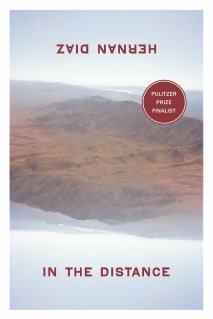
Guernica’s e-newsletter led me to a lovely poem by Charlotte Pence (daughter of Spike, not Mike), which led me to her website, which led me to this sparkling nugget, such a perfect thing to discover right after posting my review of In the Distance, Hernan Diaz’s book!

How to measure distance*
a poem by Charlotte Pence

I. Only Use Light Years When Talking to the General Public

or to squirrels testing spring between two
branches. Or to a new mother saddened
by thoughts of earth and its death; sun’s death;
her death. She watches her husband leave
the room for a burp cloth, wonders, could she
do it without him? What’s the measurement
of distance between two people growing
too close, too quickly?

II. The Measures We Use Depend on What We Are Measuring

Distance between parents? Hills? Rogue comets?
Within our solar system, distance is
measured in Astronomical Units.
Or “A.U.,” an abbreviation that
sounds similar to the “ow” of a toe
stub. Or similar to the sound of a mother
teaching the beginning of all sound. “Ah,
eh, ee, oo, uu.” Watch her mouth widen,
purr, and close. This is the measurement
for what we call breath.

III. For Most Everything Else—Stars, Galaxies, Etc…. —the Distance Unit Is the Parsec (pc). This Is a Convenient Unit

for gathering groceries, grains in silos,
gasses we cannot package and discount.

This is convenient, too, when measuring
stars’ distances by triangulation.
1 pc = 3.26 light years =
about the distance to the nearest star.

An equal sign leading to an “about.”

An estimate. A close enough.
Close enough feels safer than being wrong.
Or exact. “Close enough,” we say of that
asteroid skimming past our atmosphere’s skin.
“Close enough,” we say when he returns
with a guest towel.

IV. For Distances Within our Galaxy or Other Galaxies, It Is Kiloparsecs
She is unsure what fatherhood will do
to him. Accurate measurements require
one to know where one stands, where one belongs,
where one imagines going. Rub the toe
of the blue shoe into the dust. See how
the dust is not a bit bluer. The shoe,
a bit browner. Distance = a thing
between and against.

V. The Exception to These Units Is When One is Studying a Smaller Object

Father to mother to early zygote.
Branch to squirrel to tail-twitch and release.
Knee to toe to spring mud too soft to flake.
No units for these.

VI. One Might Say, “Its Radius Is 5 Solar Radii”, Meaning It Is 5 Times the Size of our Sun

Her fear is five times the size of sun, five
times the hours of sleep or lack thereof.
Five times the huddle of father, mother,
child. Five times the energy created
for one nap as opposed to the distance
of that nap, that leap.

VII. She Wants Answers
but is realizing that won’t happen.

She fears the truth that nothing stays the same.
Rashes fade, yet skin will prickle again.
Cries will quiet, yet the quiet will cry.
The man will leave, yet the same man will leave
again. That’s why eyes are bloodshot, why she
answers questions as if she doesn’t care.
All answers are “almost” or “about”—
everything moving. And this thing called light
years is a distance she can’t comprehend,
yet somewhere she squirms at one forever-
changing end of it.

*Note: Italics indicate lines are from NASA’s Goddard Space Flight Center website written by Jonathan Keohane.

I can’t help but draw other connections. “Au” is also:

Source of the poem: Charlotte’s website, accessed 4 January 2018, and I think the heading “Uncollected Poems” means it hasn’t been published anywhere else?

The gold In the Distance: a review of Hernan Diaz’s book

IMG_0214 (1).JPGA chance wander through a museum exhibit on British Columbia’s gold rush several years ago sparked my curiosity in California’s own gold rush in a way 4th grade history class (not to mention decades of living in that state) never managed to do; over the next several months I visited a number of gold rush sites, reading countless interpretive signs, historical marker plaques, and tourist pamphlets. I even made it through a good chunk of the massive Days of Gold: The California Gold Rush and the American Nation.

But wow, the events depicted in the fictional In the Distance by Hernan Diaz bring entirely new levels of insight and compassion to the varied and challenging realities people must have faced in those times, both externally and internally.

That said, this book is about so much more than the Gold Rush. I highly recommend it.

***

I decided to read In the Distance based on Roxane Gay’s review on Goodreads:

One of the best books I’ve read all year. The story, and the narrative voice is completely captivating. …the story itself and how it is told is absolutely unforgettable.

Fortunately for me, this book is part of Auckland Library’s vast e-book collection, and now I too can claim In the Distance as one of the best books I read in 2018.

Diaz_IntheDistance_Pulitzer_REV.jpgThe protagonist musters a surprising ability to face a range of often unfortunate conditions with equanimity and honor, while continuing to forge ahead with his seemingly-impossible quest. (In this sense he reminds me quite a bit of the convict in William Faulkner’s The Old Man, which I also loved, and which has also stayed with me quite strongly.) I was amazed at Diaz’s ability to convey interactions, landscapes, and objects through the eyes of someone who had never experienced anything like them before. Beginner’s Mind indeed!

Meanwhile, the author’s rich descriptions of San Francisco Bay, the the Sierra foothills, and deserts of America’s West, though unnamed and from a much different time, evoked more than a little nostalgia for places I know and love and am not sure when I might visit again.

Weeks after finishing it, this book still has me thinking about how we invent Purpose for ourselves. About the fine line (or is it attitude?) that differentiates Solitude from Loneliness. About those moments when we decide to Stop, and the moments when we have to Keep Going, even though we don’t want to. About Taking Stands when faced of inevitable suffering, and about Resignation when faced with the same. About Identities, both those that we choose, and those that get thrust upon us despite any desires we may have to set the record straight. About Learning, Curiosity, and Knowing, and how characters whose Obsessions are a few degrees more intense than our own serve as excellent mirrors. About Difference and Immigration. About unconsummated love and about that incessant Longing for something that lies just over the next horizon… if not even farther away.

Gordon Walters and another attempt to ride the Möbius strip out of dual thinking

When I was a kid, my dad showed me a symbol he had come up with during his days in Berkeley in the 70s. It’s confusing either way you hold it:

IMG_20181126_171308     IMG_20181126_171314

To my great delight, a similar image started showing up all over Auckland back in July:

gordon-walters-painting-j-1974.jpg
Gordon Walters, Painting J 1974
Museum of New Zealand Te Papa Tongarewa
Courtesy of the Walters Estate.
Source: The Auckland Gallery website, accessed 26 November 2018

I loved the Gordon Walters exhibit at the Auckland Art Gallery, aka Toi o Tāmaki; I went twice (the museums here are free for New Zealand residents!) and bought the catalog to add to my collection of art books addressing the spiritual in abstract art. I also thought the Gallery did a good job of describing the cultural-appropriation controversy the artist found himself in the middle of, not to mention the fact that Walters and his friend Theo Schoon apparently appropriated artistic ideas from Rolfe Hattaway, a patient in a mental hospital?!

As someone who often sees the world in terms of the potential for quilt top patterns, the show gave me all sorts of inspiration for some appropriation of my own. As of this writing I’m seriously considering a Möbius quilt, just to ensure it’s entirely impractical and complicated. And nerdy and fun.

I’m really liking the Möbius strip as a symbol for non-duality:

[T]ry to choose an “up” and a “down” on a Möbius band. When you slide along the band, you eventually wind up at the same point you started at, but “up” has become “down.” … Its storytelling potential is clear: you travel around something, only to end up back where you started but disoriented.

Thanks to Evelyn Lamb over at Scientific American for that quote. It reminds me a lot of having once been a California girl driving North up Australia’s East Coast, on a different Highway 1, behind a steering wheel on the right side of the car, my car on the left side of the road, as the sun set over the hills, not over the ocean, and the entire world felt inside-out.

Up / Down. Both / And. Wherever you go, there you are… wherever that is.

Wake up to find out that you are the eyes of the world

There’s a particular feeling I get sometimes, a paradoxical combination of “wow I am just so connected to everyone and everything right now” and “wow I am totally incapable of describing this to anyone to my satisfaction, much less sharing it with them, gotta just sit here and experience it all by myself.”

Connected / Disconnected. All One / All Alone. Everyone / No One. Everything / Nothing. Self / No Self.  Object / No Object. Lately I’ve found some comfort in the belief that it’s possible to transcend this dualistic way of interpreting experience (Möbius?!), but then what words suffice?

Sometimes, songs are the friends I am looking for / are more immediately-available reflections of my half-twist inner landscape. Inevitably, when I find myself in the aforementioned state, lyrics from a particular Grateful Dead song pop unbidden into my consciousness:

Wake up to find out that you are the eyes of the world
The heart has its beaches, its homeland and thoughts of its own
Wake now, discover that you are the song that the morning brings
But the heart has its seasons, its evenings and songs of its own

And:

Sometimes the songs that we hear are just songs of our own

Here’s my favorite version available on Spotify:

Or, if you’re that kind of nerdy, give this 19-minute version a try and see, as you’re listening, if you end up back where you started, but with a slightly different perspective.

Full lyrics: Continue reading “Wake up to find out that you are the eyes of the world”

Someone please go see the Hilma af Klint exhibit at the Guggenheim in New York and send a report

I have a lot of feelings about the Hilma af Klint: Paintings for the Future exhibit currently showing at the Guggenheim in New York City.

Screenshot 2018-10-21 at 3.56.15 PM

A Lot Of Feelings!

A sampling:

Disappointment. That I didn’t realize this show was on until a few days ago, and so didn’t plan my schedule or budget in a way that I could make the show in person. Maybe I can see it next Spring, when it’s apparently coming to MOCA in Los Angeles (according to Moderna Museet at least, why can’t I find any evidence of this upcoming show anywhere else!)? ***UPDATE 17 January 2019: that link no longer mentions such a show either. It must have been a mistake 😦

Delight! That I discovered the show’s existence in time to pre-order the catalogue at a huge discount.

Anger. Of course the female artist who was one of the first abstract artists in the world was forgotten by history.

Hope. She may have been “unknown” during her lifetime, but that’s been changing since the ’80s, when her work was first made public via an international exhibitions… who else’s life’s work is still yet to be discovered? What might this teach us about the fluidity of history, and for those of us who attempt to document the past, humility at our inevitable inability to capture it all?

Curiosity. She kept her work hidden, stipulating that it not be shown for 20 years after her death. Depending on which account you read, there are different reasons for this. Why? How might her choice inspire, or at least inform, both my own choices, and my own feelings about how things go down in the world of women, work, and sharing our creativity and life’s work with audiences at all?

Confusion. Are all the paintings in the spiral gallery? How can this layout do justice to her massive pieces? Or maybe the bigger ones aren’t included in this exhibit? Or maybe those are being shown in the adjacent galleries?

I mean I’m no curator but I’ve been an enormous fan of Hilma af Klint since I first discovered her paintings twenty years ago, and in poring over the internet for photos of other exhibits, I discover that I react very strongly to how her work has been shown in the past. Some exhibits shove the works far too close together for my liking, for instance.

I love this particular juxtaposition:

HilmaafKlintStockholm
Photo by Moderna Museet, source

And look how spectacularly they were presented in Berlin:

hilmaafklintbatmantoo.jpg
Photo by batmantoo, source

***

So yes, argh, I wish I’d known sooner so I might have made plans to visit New York while this show will be running. In the meantime, I’m imagining the opportunity to do this:

hilmaafklint-fromfloor.jpg
Source: …how can you find the original sources anymore on the internet?! I found it here, which includes a credit that I’ve tried and failed to track down further: “Photo @johanoevergaard”

Or even this:

In the meantime, I will watch this:

…and hope that someone who understands everything I have written about above will physically attend the show in person and tell me all about their experience.

Choosing to walk my own path: the beginning

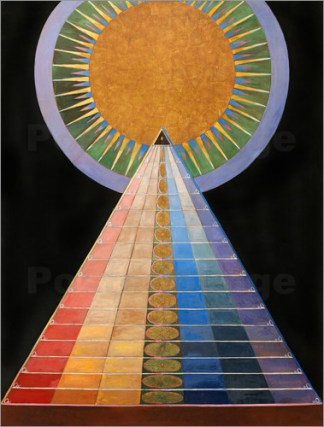
HilmaafKlint-Altar.jpg
Group X, Altar paintings #1. Hilma af Klint (c) Hilma af Klint Foundation

I keep thinking about the months of January through June of 1998. I struggle with how to label this period, because to say something like “this was a massively influential time for me” or “it was the most pivotal inflection point of my life” feels like an understatement.

Looking back, I genuinely believe that choosing to leave the life I had known up until that point allowed me to begin to discover who I was. And because I was, for the first time in my life, evaluating the world around me based on my own lens / my own value system / an expanded sense of what might be possible, I discovered several practices and perspectives that have been with me ever since.

What happened (in a nutshell)

Two and a half years into a Bachelor of Science degree at McGill University, I had become disillusioned with science as a way to explain the world. I fell into an existential crisis that called my entire approach to life into question: Why was I working toward a degree that reduced everything I loved into numbers and statistics… particularly when all the trends seemed to show that everything was doomed?

More importantly: Why was I in university at all? I certainly hadn’t made a conscious decision about the matter. Twenty years into my life, I suddenly realized I had been blindly following the path that had been laid out for me, with little regard for what I actually wanted to do, much less who I actually might be.

Then “Ice Storm ’98,” one of the worst national disasters in Canada’s history, hit…. right at the beginning of McGill’s winter semester. Continue reading “Choosing to walk my own path: the beginning”

The power of commitment

One of my Buddhist teachers, Guyhasiddhi, shared this quote in a class a few weeks ago:

Until one is committed, there is hesitancy, the chance to draw back, always ineffectiveness. Concerning all acts of initiative (and creation), there is one elementary truth, the ignorance of which kills countless ideas and splendid plans: that the moment one definitely commits oneself, then Providence moves too. All sorts of things occur to help one that would never otherwise have occurred. A whole stream of events issues from the decision, raising in one’s favour all manner of unforeseen incidents and meetings and material assistance, which no man could have dreamt would have come his way. I learned a deep respect for one of Goethe’s couplets:

“Whatever you can do or dream you can, begin it.
Boldness has genius, power and magic in it!”

In tracking down an internet source for the quote (I knew it was from The Scottish Himalayan Expedition by W. H. Murray), I discovered that this character had quite a fascinating life:

  • He was an influential Scottish mountaineer who was taken prisoner during World War II (but charmed his initial captor, apparently);
  • While in captivity (for three years!) he drafted an entire book on the topic of mountaineering in Scotland… on toilet paper;
  • This manuscript was discovered and destroyed by the Gestapo, so he started it all over again… and this version was eventually published;
  • He was active in protecting wild areas in Scotland, including a successful campaign to prevent construction of a hydroelectric dam.

What an inspiration!

Thanks yet again, Wikipedia, for coming through with the backstory.

The Well of Grief, a poem by David Whyte

Every time a crack appears in the dam that keeps my sea of grief at bay, I am reminded of this David Whyte poem:

The Well of Grief
David Whyte

Those who will not slip beneath
the still surface on the well of grief,

turning down through its black water
to the place we cannot breathe,

will never know the source from which we drink,
the secret water, cold and clear,

nor find in the darkness glimmering,

the small round coins,
thrown by those who wished for something else.

Source: David Whyte’s Facebook page, accessed 6 November 2020.

You can watch a video of the poet himself reciting the poem here (also from David Whyte’s Facebook page, accessed 10 January 2022).

I love hearing him tell the deeper story about the bottom of the well, and how he repeats certain lines, certain words, and then the entire poem in entirely different ways!