Choosing to walk my own path: the beginning

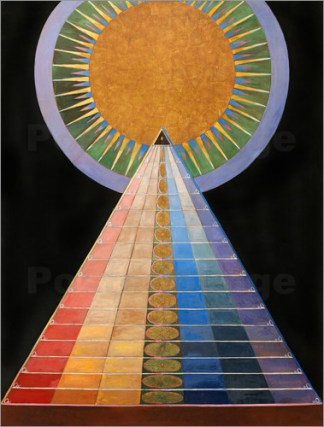
HilmaafKlint-Altar.jpg
Group X, Altar paintings #1. Hilma af Klint (c) Hilma af Klint Foundation

I keep thinking about the months of January through June of 1998. I struggle with how to label this period, because to say something like “this was a massively influential time for me” or “it was the most pivotal inflection point of my life” feels like an understatement.

Looking back, I genuinely believe that choosing to leave the life I had known up until that point allowed me to begin to discover who I was. And because I was, for the first time in my life, evaluating the world around me based on my own lens / my own value system / an expanded sense of what might be possible, I discovered several practices and perspectives that have been with me ever since.

What happened (in a nutshell)

Two and a half years into a Bachelor of Science degree at McGill University, I had become disillusioned with science as a way to explain the world. I fell into an existential crisis that called my entire approach to life into question: Why was I working toward a degree that reduced everything I loved into numbers and statistics… particularly when all the trends seemed to show that everything was doomed?

More importantly: Why was I in university at all? I certainly hadn’t made a conscious decision about the matter. Twenty years into my life, I suddenly realized I had been blindly following the path that had been laid out for me, with little regard for what I actually wanted to do, much less who I actually might be.

Then “Ice Storm ’98,” one of the worst national disasters in Canada’s history, hit…. right at the beginning of McGill’s winter semester. Continue reading “Choosing to walk my own path: the beginning”

The power of commitment

One of my Buddhist teachers, Guyhasiddhi, shared this quote in a class a few weeks ago:

Until one is committed, there is hesitancy, the chance to draw back, always ineffectiveness. Concerning all acts of initiative (and creation), there is one elementary truth, the ignorance of which kills countless ideas and splendid plans: that the moment one definitely commits oneself, then Providence moves too. All sorts of things occur to help one that would never otherwise have occurred. A whole stream of events issues from the decision, raising in one’s favour all manner of unforeseen incidents and meetings and material assistance, which no man could have dreamt would have come his way. I learned a deep respect for one of Goethe’s couplets:

“Whatever you can do or dream you can, begin it.
Boldness has genius, power and magic in it!”

In tracking down an internet source for the quote (I knew it was from The Scottish Himalayan Expedition by W. H. Murray), I discovered that this character had quite a fascinating life:

  • He was an influential Scottish mountaineer who was taken prisoner during World War II (but charmed his initial captor, apparently);
  • While in captivity (for three years!) he drafted an entire book on the topic of mountaineering in Scotland… on toilet paper;
  • This manuscript was discovered and destroyed by the Gestapo, so he started it all over again… and this version was eventually published;
  • He was active in protecting wild areas in Scotland, including a successful campaign to prevent construction of a hydroelectric dam.

What an inspiration!

Thanks yet again, Wikipedia, for coming through with the backstory.

The Well of Grief, a poem by David Whyte

Every time a crack appears in the dam that keeps my sea of grief at bay, I am reminded of this David Whyte poem:

The Well of Grief
David Whyte

Those who will not slip beneath
the still surface on the well of grief,

turning down through its black water
to the place we cannot breathe,

will never know the source from which we drink,
the secret water, cold and clear,

nor find in the darkness glimmering,

the small round coins,
thrown by those who wished for something else.

Source: David Whyte’s Facebook page, accessed 6 November 2020.

You can watch a video of the poet himself reciting the poem here (also from David Whyte’s Facebook page, accessed 10 January 2022).

I love hearing him tell the deeper story about the bottom of the well, and how he repeats certain lines, certain words, and then the entire poem in entirely different ways!

When the medium limits the message

Here are three offerings that really drove home the whole “the medium is the message” message for me this week. I’ll share more of my own thoughts in separate posts; here, I’ll let the artists speak for themselves.

One: Hannah Gadsby’s Nanette [this is just the trailer, you can read more of my thoughts on it here]:

Two: This video essay from Lindsay Ellis [more of my thoughts on this video here]:

…and Three: something my friend Ethan wrote in the description of the Kickstarter campaign for his latest art book, The Evening Pink. [Please give him your support! And I’ve written up more thoughts about slow, thoughtful engagement, etc, here:

I am concerned about the distribution and reach of independent cultural production in 2018. The last time I pre-ordered an edition, in 2012, the cultural landscape was quite different. We used blogs! Artists are now producing more content for less pay, on channels that ask for shorter encounters with artworks. This is discouraging when you make books, and want to facilitate a slow, thoughtful engagement.


Manufacturing authenticity

In her video essay YouTube: Manufacturing Authenticity (For Fun and Profit!), Lindsay Ellis casts a very self-conscious, very critical eye on YouTube vlogs as an “authentic” phenomenon + livelihood… starting with, of all things, an analysis of the evolution of a couple of cake decorating channels.

I realize this one sounds like it’s a lot heavier on YouTube-specific geekery than most people would appreciate, but I recommend this video to anyone who recognizes that forging a connection with your audience (whomever and whatever that audience may be!) is an important way to get people coming back for whatever it is you want people to come back to you for (be it your videos, your music, your writing, your art).

And I especially recommend this video to everyone who has experienced the heightened trickiness of this territory whenever your livelihood depends in some way upon a public image you must therefore maintain.

So many insights into these juicy topics in this video. And in a stroke of brilliance, Lindsay interviews YouTube darling (and one of my faves) Hank Green, in a textbook tactic from Google’s YouTube best practices playbook: Create, Collaborate, Curate!

There’s a really great section on the history of emotional labor, leading into the impact of trying to maintain an internet persona, starting here. And she gets Hank to talk about why he does what he does here:

I want people to get excited about the universe and the world and… thinking critically and hard about stuff. More and more I want to foster some kind of better communication among people, and also more and more I feel like that needs to happen a lot more OFF of the internet than is happening now… we need to occupy the same physical space as other human beings.

I could not figure out how to get a transcript from this video. 12 points for anyone who knows the trick!

Sometimes life isn’t comedy: Hannah Gadsby’s Nanette

Hannah Gadsby’s Nanette. There are so many things she nails in this… well, calling it “a Netflix Special” is I suppose technically accurate, if ridiculously insufficient. I’m sure I’m not the first person to implore you to watch it.

Out of all her spot-on revelations and observations about human nature, it’s her critique of the medium of a comedy show that has really stuck with me, though this says more about me and what I’m grokking lately than it does about her; which medium best fits which messages? I am so curious to see what medium she chooses next!

A note for readers like me who prefer to sit with written words in order to fully process something, I found this transcript, but do watch the whole thing first if you can; this is just the trailer.

The stars sing too / I know they know me back

Back in April an acquaintance shared a song she’d just released:

This part in particular really hits me:

I talk to the stars I know they know me back
You talk to the dark I know it holds you back

Then, just last week, my favorite English teacher from high school shared a Mary Oliver poem with me (see below, thanks Ellen!). I’d like to imagine ARA’s song was inspired by this poem, and in particular, this line:

So fancy is the world, who knows, maybe the stars sing too,

Here’s the whole thing:

This World
by Mary Oliver

I would like to write a poem about the world that has in it
nothing fancy.
But it seems impossible.
Whatever the subject, the morning sun
glimmers it.
The tulip feels the heat and flaps its petals open and becomes a star.
The ants bore into the peony bud and there is a dark
pinprick well of sweetness.
As for the stones on the beach, forget it.
Each one could be set in gold.
So I tried with my eyes shut, but of course the birds
were singing.
And the aspen trees were shaking the sweetest music
out of their leaves.
And that was followed by, guess what, a momentous and
beautiful silence
as comes to all of us, in little earfuls, if we’re not too
hurried to hear it.
As for spiders, how the dew hangs in their webs
even if they say nothing, or seem to say nothing.
So fancy is the world, who knows, maybe they sing.
So fancy is the world, who knows, maybe the stars sing too,
and the ants, and the peonies, and the warm stones,
so happy to be where they are, on the beach, instead of being
locked up in gold.

Continue reading “The stars sing too / I know they know me back”

Nai Palm is an invitation to blossom

What is it about witnessing someone who is so comfortable sharing their own genius that it calls the rest of us to get serious about cultivating, if not also sharing, our own?

…genius must be invited out of a person. People carry to this world something important that they must deliver… To see the genius in a young person is to give it the fertile ground required for it to burst forth and blossom, for it is not enough to be born into this world loaded with such a beauty.

–Malidoma Patrice Some, from his book The Healing Wisdom of Africa, 1999, TarcherPerigee.

There have been exactly two instances in the last year when someone’s live performance cracked open some sort of direct connection between me and the source of creativity (and yes, I realize how woo woo that sounds): one was Feist’s concert at the Powerstation in November, and the other was watching Nai Palm perform solo at the Tuning Fork a few weeks ago.

I don’t even particularly love Nai Palm’s style of music (you might be familiar with her as the frontwoman for Hiatus Coyote?), but there is simply no denying her talent. And perhaps more importantly, her PRESENCE.

And the day came when the risk to remain tight in a bud was more painful than the risk it took to blossom.

–Usually attributed to Anaïs Nin, but the source remains mysterious.

I couldn’t decide which of these to share, so here are two videos of Nai Palm performing Jimi Hendrix’s Electric Ladyland Continue reading “Nai Palm is an invitation to blossom”

Every weekend can be a three-day weekend: my journey to a four-day work week

As of this week, I officially work Tuesdays through Fridays. Standard eight-hour days, but only four of them. Every weekend is now a three-day weekend, and I am thrilled!

This wasn’t a decision that I took lightly, and the process revealed a few surprises. It took several months from the time I started thinking about it to actually make a formal request, and a couple more months for it to be made official. Here’s some of what I learned over the course of those months (about myself, about my relationship, and about The System), and what it took to make it happen. I’m writing this all out in hopes that it might serve as inspiration for anyone else who is thinking of reducing their working hours, and also provide some perspective that’s a little deeper than what can be conveyed in a headline.

***

The company I work for was not the barrier. Xero has verrrrrry flexible policies when it comes to working hours. They even have a series of internal publications showcasing people’s flexible work arrangements. People have reduced their hours for reasons as varied as wanting to avoid rush-hour traffic, to wanting to spend more time with their kids (temporarily or permanently), to training for and representing their country at international sporting events. (We’re hiring, wanna move to New Zealand?! Or Singapore or Melbourne or Denver or…? Let me know if there’s a role you’re interested in and I can send you the internal referral link!)

Benefits weren’t a factor. Everyone who lives in New Zealand, either permanently or on a visa that’s longer than 24 months, is covered by the national health care system, and all other benefits (vacation, sick time) would be prorated according to my new schedule.

I worried a bit about letting my team down, but the truth of the matter is that my working fewer hours would bring our workflows into much better alignment, as the person who does a lot of the post-production on the videos we make together is also on a four-day schedule! Without exception, everyone on my team cheered me on as soon as I told them what I was hoping to do.

My partner wasn’t holding things back, either. Quite the opposite, Scott’s been encouraging me to reduce my working hours for ages. Continue reading “Every weekend can be a three-day weekend: my journey to a four-day work week”