What’s your crystal shop? A lesson from The Alchemist

The Alchemist.jpgTonight I’m thinking about the crystal shop in Paolo Coelho’s book The Alchemist. It’s been over twenty years since I read the copy I “borrowed” from my cousin Matthew (!!!) so I’m a bit fuzzy on the details, but here’s what I remember: the protagonist is on his journey (the Hero’s Journey, the monomyth), and at some point he ends up asking a crystal merchant for a job.

It turns out he’s pretty good at selling crystals. Not only that, but he ends up coming up with all sorts of excellent business ideas, and things are going great.

…except that our hero didn’t set out from home to do a great job selling crystals. If anything, hanging out with the crystal merchant has made him a bit complacent, and the reader wonders if he’s completely lost sight of his goal.

At one point the protagonist is trying to figure out why his boss, who keeps talking about his big dream of going to Mecca, isn’t doing anything that would help him actually get there:

“Well, why don’t you go to Mecca now?” asked the boy. “Because it’s the thought of Mecca that keeps me alive. That’s what helps me face these days that are all the same, these mute crystals on the shelves, and lunch and dinner at that same horrible café. I’m afraid that if my dream is realized, I’ll have no reason to go on living.”

Of course you want to just shake the guy: “What are you waiting for?! You’re not getting any younger, Mecca isn’t going to come to you!”

But you can’t very well judge, because you know that you’ve been in that exact place yourself.  Continue reading “What’s your crystal shop? A lesson from The Alchemist”
If the Buddha wrote a bio

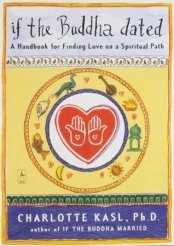
If the Buddha Dated.jpgYou might have seen these books: If the Buddha Dated, If the Buddha Married? I loved the section in If the Buddha Dated on writing a dating profile that might attract an appropriate mate. Author Charlotte Kasl takes the reader through the various versions that you might write, starting with one that’s basically a laundry list of all the qualities you are seeking in your would-be partner. As she continues, the profiles get a little more “enlightened” and more and more interesting, and you start realizing that perhaps describing your values, and asking questions, might be more effective than presenting an impossible checklist of criteria and scenarios that might not ultimately lead to a mutually-fulfilling relationship, anyway.

The final sample profile simply reads,

Who are you? Who am I?

I’ve been thinking a lot about this because it’s now been exactly 27 days since I was asked to write a bio for the Order members of my Buddhist community, or sangha, as Buddhist communities are known.

Now I am nothing if not a writer, and I have no problem writing bios; I’ve written gobs of them. Bios for online dating profiles (at least four different ones I am sure about, and probably more, all partially inspired by Charlotte Kasl, if decidedly more verbose). Bios for speaking gig programs. Bios for job applications, for teaching yoga, for the inside of my book, for websites, for fellowship directories, for high school and grad school alumni journals. 20 word bios. 120 word bios. 250 word bios, one-pagers. The list goes on and on.

So why is this one stumping me?!

The thought process goes something like this: “I’d better do this one properly. Wait, no, I’d better make it seem like I wasn’t worried about it at all, that’s more ‘spiritual.’ Continue reading “If the Buddha wrote a bio”

Tūrangawaewae: the place where you belong

When does one fully belong to a place?

I first learned the word / concept of tūrangawaewae during a lesson in Māori pronunciation at work. The colleague who offered the class described tūrangawaewae as the place where you feel like you belong, or your spiritual home, regardless of where you are actually from.

The Māori Dictionary defines tūrangawaewae as follows:

domicile, standing, place where one has the right to stand – place where one has rights of residence and belonging through kinship and whakapapa.

Also from the Māori Dictionary (and all these links contain recordings of the words so you can hear how they sound), here are the definitions of the two parts of the word:

tūranga: stand, position, situation, site, foundation, stance

waewae: leg, foot, or footprint

Also important:

whakapapa: genealogy, genealogical table, lineage, descent. Reciting whakapapa was, and is, an important skill and reflected the importance of genealogies in Māori society in terms of leadership, land and fishing rights, kinship and status. It is central to all Māori institutions.

What I like about my colleague’s explanation of tūrangawaewae  Continue reading “Tūrangawaewae: the place where you belong”

Your Money Or Your Life: one of the most influential books of my life

vicki
Of course this woman is one of my role models (Source: yourmoneyoryourlife.com)

I finally had a chance to read the new edition of Your Money Or Your Life: 9 Steps to Transforming Your Relationship with Money and Achieving Financial Independence, a book that had a huge influence on me when I first discovered it back in the late ’90s.

With this book, co-author (and now friend!) Vicki Robin sparked the FIRE, or  “Financial Independence, Retire Early” movement… though few people were aware of this until relatively recently. She is a huge inspiration to me, and I definitely aim to be like her when I grow up!

The new edition includes a wider range of examples from Millennial types, and the chapter on investing is FAR better aligned to today’s investing climate.

YMOYLIntrigued? Vicki has generously shared a VERY detailed summary on the fancy new YMOYL website, but I still suggest you buy the book, and spend some time with it!

In addition to calculating how much money we’ve earned over our entire lives, and what we have to show for it (aka our net worth; this is Step 1), we’re instructed to calculate our real hourly wage, a function of our life energy, and track every cent that comes into our goes out of our lives (Step 2). And we get into the habit of tallying up our spending by categories that are relevant to our lives, and we regularly convert those monthly spending totals into hours of life energy (Step 3).

But my favorite step by far is Step 4: Three Questions That Will Transform Your Life: Continue reading “Your Money Or Your Life: one of the most influential books of my life”

How to get your body caftan-ready for summer

The boys at work have been playing (and singing!) this song:

…which will forevermore remind me of the excellent article from which I stole the title of this post, thank you :

1. Select a caftan of your chosen gauge and length. Stroke its gauzy fabric and whisper into its folds.

2. Let your flesh settle into the crevices of your comfortable, comfortable caftan.

3. Crumbs? Let them fall where they may, swaddled in your caftan.

4. Throw out your razor.

5. Throw out your bra.

6. Throw out the aloe vera lotion you bought last summer. You will not be getting sunburned this summer.

7. Release your inhibitions. Feel the rain on your skin.

I’ve been itching to write about, in no particular order: the time I thought I needed to buy all new clothes to be more “feminine” because I had internalized all this male gaze crap and even went so far as to send emails back and forth with a few different personal stylists I was going to spend $$$ with and install a frikken wardrobe app on my phone and almost decided to grow my hair out, and then I randomly stumbled across an article by Cynara Geissler in The Establishment entitled ‘Toddler Grandma Style,’ The Fashion Approach That Will Set You Free: Continue reading “How to get your body caftan-ready for summer”

How to evaluate a fundraising opportunity

A friend of mine in North Carolina is working on what sounds like a really awesome climate change video, and he recently asked me for fundraising advice. Here are the key points of the conversation, which I hope will benefit other people who know they’ll need money in order to launch an ambitious creative project.

“I’m starting to look around for capital,” he wrote to me, “namely philanthropists who won’t expect anything back. Any ideas about who might want to invest? I’m also thinking of going to SoCap in San Francisco, in October. Is that worthwhile?”

(SoCap is a big impact investing conference in San Francisco, and I’ll get into that in more detail in a minute.)

I love this stage of a project, when anything is possible! And of course it can be daunting, especially with something like a film that requires so much money to get off the ground. My friend is super smart to be thinking about fundraising early on in the process, and this is true of most projects: fundraising takes a LOT longer than you think it will, so if you know your’e going to need money at some point, start putting your fundraising plan together sooner rather than later!

The first thing that caused me a bit of alarm about his email was that he was using the terms “philanthropy” and “investing” interchangeably. Continue reading “How to evaluate a fundraising opportunity”

Shitty things men do to women at concerts, and how not to be complicit

I am still really shaken by something I experienced / witnessed last Saturday night at a concert. Don’t want to read the distressing details? Here’s the take-home message:

DECENT MEN: if a friend of yours, or any guy you witness, is behaving like a #metoo wrecking ball at a show, or anywhere, let him know that what he’s doing is not OK. At the very least, check in with the women he’s preying on to make sure they’re alright.

***

I had been looking forward to the Unknown Mortal Orchestra show for a while, and reaallllly wanted to enjoy it. (A note for the uninitiated: they are NOT an orchestra!)

…but very unfortunately, the whole night was tainted by the behavior of a predatory dude working the floor where in the area where Scott and I were standing. We watched him making the rounds, repeatedly going up to women and attempting to manhandle them (embrace, kiss, and literally pick them up, dragging them away from their friends).

Then came the moment when I had to physically shove him away from my own body.

Continue reading “Shitty things men do to women at concerts, and how not to be complicit”

Leisure, a poem by William Henry Davies

My friend Nadim just shared what tells me is his favorite poem, and has been since he was a child. Kinda hits me in the stomach:

Leisure
by William Henry Davies

What is this life if, full of care,
We have no time to stand and stare.

No time to stand beneath the boughs
And stare as long as sheep or cows.

No time to see, when woods we pass,
Where squirrels hide their nuts in grass.

No time to see, in broad daylight,
Streams full of stars, like skies at night.

No time to turn at Beauty’s glance,
And watch her feet, how they can dance.

No time to wait till her mouth can
Enrich that smile her eyes began.

A poor life this if, full of care,
We have no time to stand and stare.

Source: Songs Of Joy and Others, published in 1911 by A. C. Fifield (accessed via Wikipedia on 11 Sept 2018).

Keeping the baby AND the bathwater

We are complicit with everything we buy and click on and watch.

I’ve been struggling for months (if not years? decades?) to make sense of where to file the work of once-favorite actors, artists, comedians, scientists, authors, thinkers, etc who turn out to have done some very awful things (see: #metoo).

A couple weeks ago, someone suggested that I consider integrating both the baby AND the bathwater, rather than trying to figure out what to keep and what to toss. The idea of this approach appeals to me… but how?

This Art Assignment video does an excellent job of both articulating the conundrum and describing what’s actually at stake / why what we choose to do matters. Host Sarah Urist Green outlines a few approaches (including some both/and AND either/or options), and poses some very relevant questions to ponder as we each grapple with how to appreciate someone’s content, even as we condemn their behavior:

In addition to the quote I included above, here are a couple more that stood out to me from the video, but I highly recommend you watch it all if you’re at all interested in these issues.

Who reaps the financial rewards of our attention?

The context of this one was the question of whether or not to watch the latest controversial YouTube video, but the larger point is that these choices have impacts in any genre:

I can’t bear to think that I’ll… contribute financially in any way to that person and their fame. Our attention matters, and it’s also being closely monitored, amounting to ad dollars and influencing boardroom decisions about what kind of stuff gets made.


Digital Desk + Analog Desk + Day Bed = My Ideal Creating Space

My new workspace arrangement has completely transformed my room from a place I rarely used to a place I can’t wait to come home to / spend all evening / all day getting creative / hanging out in.

IMG_20180908_160300

Ever since Scott helped me set it up, I’ve had these words from a Jean LeLoup song stuck in my head:

Mon lit est un navire
Un atelier où je vais pour l’éternité

…which roughly translates to, “my bed is a ship / a studio where I’m going for eternity.”

I had been doing a project that required more space than my little desk could accommodate, and had brought a whole pile of books / post-it notes / big sheets of paper / pens / my computer out to the dining room table. Several days later, it was really bugging me to have all that clutter in our living space, but I still wanted everything to be accessible… so I decided to move my big table from the garage and into my room.

After trying out several configurations of furniture, Scott suggested I leave BOTH desks in there, move my wine-box bookshelves (which hold all my writing and painting tools in addition to books) next to the main desk, and move the bed under the windows. And there’s still tons of room for yoga in between.

Having two desks means that I can now implement an idea Austin Kleon suggests in his book Steal Like An Artist: keep separate digital and analog desks. Continue reading “Digital Desk + Analog Desk + Day Bed = My Ideal Creating Space”